In today’s rapidly evolving technological landscape, the intersection of hardware and software has opened up a world of possibilities for enthusiasts, engineers, and hobbyists alike. From sophisticated simulation systems to practical data logging solutions, modern devices are transforming the way we interact with electronics. Understanding these tools and their applications is essential for anyone looking to harness their potential effectively.
This article explores four distinct yet interconnected topics: the versatile PoKeys57E, the functionality of an rc simulator interface, the practicality of a Raspberry Pi temperature logger, and the capabilities of modern DAQ devices. Each of these subjects represents a unique facet of technological innovation, demonstrating how precision, control, and data collection have become increasingly accessible.
By examining these topics in a question-and-answer format, we aim to provide clear insights into their uses, features, and practical applications, while highlighting how they can enhance both hobbyist projects and professional setups. Whether you are a seasoned engineer or a curious beginner, this article will serve as a comprehensive guide to understanding these technologies and exploring their potential.
What is PoKeys57E and how can it be used in modern electronic projects?
The PoKeys57E is a highly versatile device designed to bridge the gap between physical hardware and software control, making it an essential tool for hobbyists, engineers, and industrial users alike. At its core, the PoKeys57E serves as a multifunctional interface that provides both digital and analog inputs and outputs, enabling precise control over various electronic systems. One of the standout features of the PoKeys57E is its ability to integrate seamlessly with a wide range of software environments, allowing users to automate processes, monitor systems, and execute complex tasks with relative ease. This flexibility makes it ideal for applications ranging from CNC machines and home automation systems to laboratory experiments and DIY electronics projects.
One of the primary advantages of the PoKeys57E is its extensive connectivity options. It supports USB communication with computers, allowing users to program and control it through dedicated software tools. This connectivity ensures that the PoKeys57E can function as a central hub in a project, coordinating inputs from sensors and switches while managing outputs to motors, lights, or other actuators. The device also supports Modbus and other industrial communication protocols, which expands its utility beyond hobbyist projects into professional and industrial applications. With its ability to handle multiple input and output channels simultaneously, the PoKeys57E provides a level of precision and reliability that is difficult to achieve with simpler microcontroller boards.
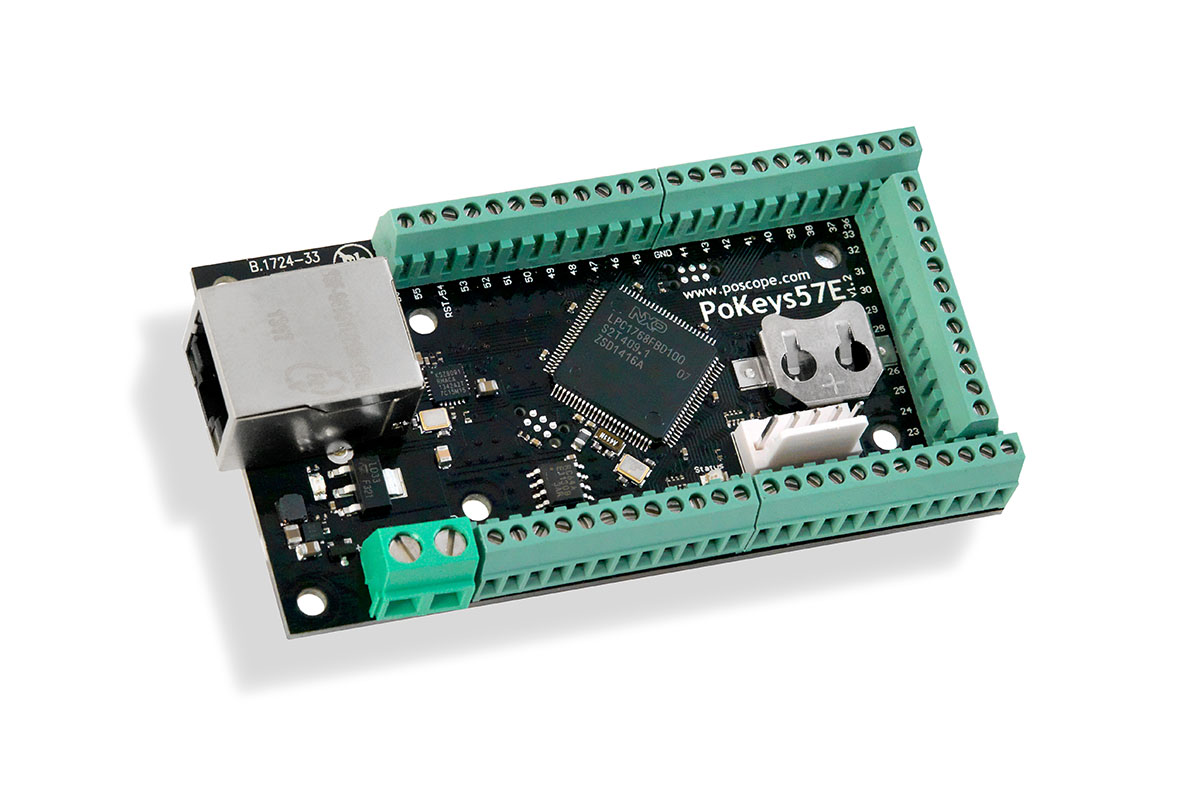
In addition to its connectivity, the PoKeys57E is highly programmable. Users can create custom scripts to define how the device responds to different inputs, allowing for intricate automation schemes and responsive control systems. This programmability makes the PoKeys57E particularly valuable for applications where timing and accuracy are critical, such as robotics, motion control systems, and sensor data collection.
By leveraging the device’s analog inputs, users can measure voltage levels from temperature sensors, potentiometers, or other analog devices, while digital inputs can track the state of switches or buttons in real-time. This combination of inputs and outputs makes the PoKeys57E a comprehensive solution for projects requiring robust interaction between software and hardware.
Another important aspect of the PoKeys57E is its user-friendly interface and strong community support. The manufacturer provides detailed documentation, tutorials, and example projects that help new users quickly understand how to integrate the device into their setups. Moreover, the PoKeys57E is compatible with a variety of third-party software platforms, further enhancing its versatility.
Whether it is being used in a custom rc simulator interface, an automated home system, or a laboratory experiment, the PoKeys57E consistently demonstrates its value by simplifying complex control tasks and enabling precision management of electronic systems. The device’s combination of flexibility, programmability, and connectivity ensures that it remains a go-to solution for anyone looking to elevate their hardware projects to a professional level.
What is an rc simulator interface and why is it important for hobbyists and professionals?
An rc simulator interface serves as the crucial connection between a physical radio control transmitter and simulation software running on a computer. For both hobbyists and professional users, this interface provides the ability to practice and refine control skills in a safe, virtual environment before taking real-world action. Using an rc simulator interface, pilots can train on complex maneuvers, experiment with different aircraft or vehicle setups, and troubleshoot potential issues without risking expensive equipment or causing accidents. The interface essentially translates the signals from a physical transmitter into a digital format that the simulator can interpret, ensuring accurate representation of the controls and realistic feedback for the user.
One of the key benefits of an rc simulator interface is that it allows users to gain experience with a variety of models and configurations that might otherwise be difficult or expensive to access. By connecting a standard rc transmitter through the interface, the simulator can replicate the behavior of airplanes, helicopters, drones, and cars with astonishing realism. This capability is especially valuable for beginners who are still learning the basics of rc control, as well as for advanced users who wish to test advanced flight techniques or competitive racing strategies. The interface provides the precision necessary to ensure that inputs from the transmitter correspond exactly to the movements within the simulation, giving users confidence that skills developed in the virtual world will translate effectively in reality.
Another important feature of rc simulator interfaces is their adaptability and compatibility. Many modern interfaces support multiple brands and types of transmitters, making them flexible tools for users who own a variety of rc equipment. They also often provide adjustable sensitivity and calibration options, allowing pilots to fine-tune the simulator experience to match their specific hardware setup. This level of customization enhances the learning experience and ensures that users can practice in a manner that closely mirrors real-life conditions. Moreover, certain rc simulator interfaces can integrate with devices like the PoKeys57E to expand the range of inputs and outputs, enabling advanced simulations with additional sensors, switches, or feedback mechanisms.
For serious hobbyists and professionals, the rc simulator interface is more than just a training tool—it is a platform for experimentation and optimization. By simulating different environmental conditions, control responses, and vehicle behaviors, users can identify the best configurations for performance and safety. This makes it a valuable component not only for personal skill development but also for testing setups before competitive events or professional projects. Whether used in conjunction with a sophisticated PoKeys57E for input management or as a standalone training tool, the rc simulator interface enhances precision, control, and understanding of complex rc systems. Its ability to replicate real-world behavior while protecting hardware from potential damage makes it an indispensable resource in the rc community.
How does a Raspberry Pi temperature logger work and what are its practical applications?
A Raspberry Pi temperature logger is a versatile and cost-effective solution for monitoring environmental conditions over time. By combining the compact computing power of a Raspberry Pi with temperature sensors and data storage capabilities, this setup allows users to track temperature fluctuations in real-time, store historical data, and even visualize trends through software interfaces. The primary advantage of a Raspberry Pi temperature logger lies in its flexibility: it can be tailored for a wide range of applications, from home automation and greenhouse monitoring to laboratory experiments and industrial processes. Users can connect digital or analog temperature sensors to the Raspberry Pi’s GPIO pins and program the system to record data at specific intervals, creating a continuous log that can be analyzed later.
One of the key features of a Raspberry Pi temperature logger is its ability to operate autonomously. Once configured, it can run continuously, collecting data and storing it locally or uploading it to cloud-based services for remote monitoring. This makes it ideal for situations where constant supervision is impractical or where precise historical data is essential for analysis. For example, in a greenhouse, a Raspberry Pi temperature logger can detect subtle changes in temperature that might affect plant growth, alerting users to potential problems before they escalate. Similarly, in a laboratory setting, the device can ensure that experiments requiring strict temperature control are conducted within precise parameters, with every fluctuation documented for later review.
The Raspberry Pi temperature logger also benefits from the Raspberry Pi’s extensive programming and networking capabilities. Users can write scripts in Python or other programming languages to customize data collection, trigger alerts when temperatures exceed defined thresholds, and even integrate with other devices such as PoKeys57E units or DAQ devices for more complex automation systems. Its compatibility with web interfaces and data visualization tools allows users to generate graphs, charts, and reports, providing clear insights into temperature trends. The system’s modular nature means that additional sensors or functionalities, such as humidity measurement or remote control of fans and heaters, can be incorporated easily, making it a highly adaptable solution.
Another significant advantage is the affordability and accessibility of a Raspberry Pi temperature logger. Unlike specialized industrial monitoring equipment, a Raspberry Pi-based system offers comparable functionality at a fraction of the cost, while also allowing hobbyists and educators to explore data logging, programming, and electronics firsthand. By combining the Raspberry Pi temperature logger with devices like DAQ modules or integrating it into a broader rc simulator interface, users can create sophisticated monitoring and control systems that provide valuable real-world data. Its combination of ease of use, customizability, and low cost has made the Raspberry Pi temperature logger a popular choice for anyone seeking reliable environmental monitoring, whether for personal projects, research, or professional applications.
What are DAQ devices and how do they enhance data collection and analysis?
DAQ devices, or Data Acquisition devices, are specialized tools designed to measure, record, and process physical signals from the real world. These devices serve as the critical bridge between sensors, instruments, or machinery and digital systems, allowing engineers, scientists, and hobbyists to monitor and analyze a wide variety of parameters such as voltage, current, temperature, pressure, and motion. The core function of a DAQ device is to convert analog signals into digital data that can be processed by computers or microcontrollers, providing accurate and reliable measurements that inform decisions, control systems, or research projects. With their high precision and versatility, DAQ devices have become indispensable in both professional laboratories and advanced hobbyist setups.
One of the primary advantages of DAQ devices is their ability to handle multiple input channels simultaneously. This capability allows users to collect data from a range of sensors at the same time, enabling comprehensive monitoring of complex systems. For instance, in an experimental setup, a DAQ device can simultaneously track temperature, pressure, and voltage across multiple points, providing a synchronized dataset that simplifies analysis and troubleshooting. Modern DAQ devices also offer a wide variety of input types, including analog, digital, and counter inputs, making them suitable for a diverse range of applications. This flexibility allows users to integrate DAQ devices into existing systems, including Raspberry Pi temperature loggers or PoKeys57E setups, expanding the functionality of these devices and enabling more sophisticated automation and control projects.
Another significant aspect of DAQ devices is their programmability and integration with software. Users can utilize dedicated applications or custom scripts to define sampling rates, trigger conditions, and data processing routines. This means that DAQ devices are not just passive recorders but active tools for capturing meaningful insights. For example, a DAQ device connected to a laboratory experiment can automatically log data when certain thresholds are reached, or it can be integrated with control systems to adjust environmental conditions in real-time. By providing precise, high-resolution data, DAQ devices support advanced analysis such as signal processing, statistical evaluation, and predictive modeling, which are essential for both research and industrial applications.
In addition to their technical capabilities, DAQ devices are valued for their reliability and robustness. Industrial-grade models are designed to operate under challenging conditions, including extreme temperatures, vibrations, and electrical noise, ensuring accurate data collection even in demanding environments. Hobbyists and educators also benefit from more affordable DAQ devices that provide professional-grade features in smaller, more accessible packages. When combined with systems like a Raspberry Pi temperature logger, an rc simulator interface, or a PoKeys57E, DAQ devices expand the scope of projects by offering precise measurement, control, and data analysis in one integrated solution. Their role in bridging the physical and digital worlds makes them a cornerstone of modern electronics, automation, and experimentation.
More:
Conclusion
In exploring the PoKeys57E, rc simulator interface, Raspberry Pi temperature logger, and DAQ devices, it becomes clear how interconnected modern electronics and data systems have become. Each of these tools serves a unique purpose, yet they all share a common goal: transforming real-world signals and actions into precise, controllable, and analyzable data. The PoKeys57E provides versatile input and output management for both hobbyist and professional projects, while rc simulator interfaces allow safe, realistic practice and experimentation in virtual environments. Raspberry Pi temperature loggers demonstrate how accessible data monitoring can be, bridging programming, electronics, and environmental awareness. DAQ devices, with their high precision and multi-channel capabilities, offer a professional-grade solution for capturing and analyzing complex signals. Together, these technologies highlight the power of integrating hardware, software, and data, enabling users to innovate, experiment, and optimize systems across a wide spectrum of applications. Embracing these tools opens doors to a world of possibilities, whether in learning, research, or advanced project development.